
Touge master
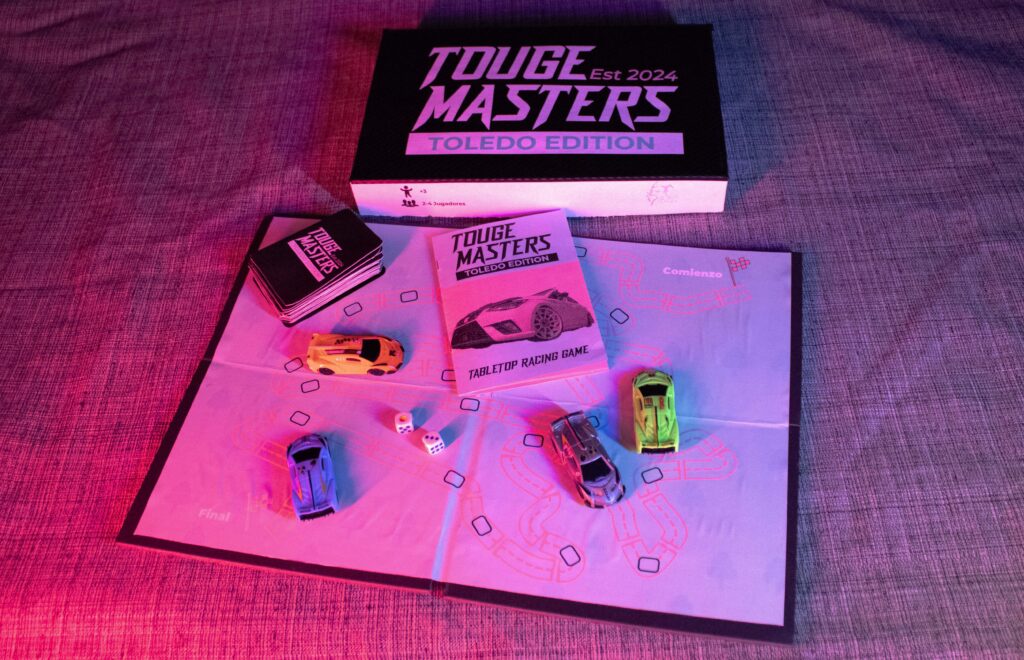
Sure! Here?s a concise overview of the printing process, especially in the context of tabletop games like Touge Master, which may involve cards, boards, or rulebooks:
1.Design Preparation
- All game components (cards, board, box, tokens, rulebook) are designed digitally using software like Illustrator, InDesign, or Photoshop.
- Files must include bleed areas (extra margin) to avoid white edges after trimming.
- Colors are often prepared in CMYK (Cyan, Magenta, Yellow, Black) for printing accuracy.
- Designers send files to the printer; the files are checked for errors, color accuracy, and proper resolution (300?dpi for most print materials).
- Printer may create a proof (sample page) to confirm everything looks correct.
Common methods used for board games:
- Offset Printing (most common for large runs)
- Uses metal plates to transfer ink onto paper or cardboard.
- Very precise and cost-effective at scale.
- Ideal for cards, boards, and boxes.
- Digital Printing (good for small runs or prototypes)
- Prints directly from the digital file onto the material.
- Faster setup, cheaper for limited quantities, but slightly higher cost per unit.
2. Finishing
- Cutting & Die-cutting: Cards, boards, and tokens are cut to shape. Special shapes require die-cut molds.
- Lamination / Coating: Optional protective layer (matte or gloss) to prevent wear and improve durability.
- Assembly: Boxes are folded, glued, and packaged with all components.
3.Quality Control
- Checks for color consistency, cut accuracy, and alignment.
- Any misprints or defects are discarded or corrected.
In short: Design ? Prepress ? Print ? Finish ? QC ? Pack. For a game like Touge Master, most components (cards, board, box) are likely offset printed for quality, with protective coatings for durability.